
Written by:
Sandro Kriesch
ARCAS Managing Director, Head of ILS
Sacha Collinson
ARCAS Analyst
Prof. Dr. Louise Harra
Full Professor, Department of Physics, ETH Zurich
About this paper
A ‘solar storm’ is a sudden and intense burst of radiation and energetic particles blasted from the Sun. If large enough and directed towards Earth, the resulting ‘space weather’ has the potential to severely damage critical infrastructure and create significant disruption across multiple industries and our everyday activities.
This paper is provided for informational and educational purposes only and does not constitute investment advice, a recommendation to buy or sell any security or insurance product, or an offer or solicitation of any kind. The views expressed are those of the authors and do not necessarily reflect the views of Acrisure Re or its affiliates. This paper contains forward-looking statements and projections based on current expectations and assumptions that are subject to significant risks and uncertainties. Actual results may differ materially from those projected. Readers should not place undue reliance on forward-looking statements. None of these statements projects or predicts the performance of any security or investment.
1. Executive Summary
Severe space weather is an emerging systemic risk to modern society. Earth-directed coronal mass ejections can induce currents that damage power grids and disrupt satellites, GPS and communications, as the 1989 Quebec blackout and the May 2024 Gannon storm showed. Estimates put the recurrence of a Carrington-class storm at roughly 80 to 420 years, and a repeat today could cause global losses of hundreds of billions to several trillion USD, mainly through prolonged grid outages. For insurers, the peril is highly accumulative and can cause losses without physical damage, so it is poorly suited to traditional cover, whereas its objective, publicly measured triggers make it a good fit for parametric solutions. We recommend that insurers monitor the peril and test a 1-in-200-year scenario, and that at least a Quebec-scale event be built into national resilience planning.
2. How the Sun affects us
The Sun is our star and provides us with heat and light to live on Earth. It is a middle-aged and, in many ways, unremarkable ‘average’ star made only remarkable by our close vicinity to it. The Sun generates heat through nuclear fusion of hydrogen atoms at its core, which, when they fuse together, 0.645% of the mass is converted into energy. Every second 620 million metric tons of hydrogen are converted to energy creating the heat and light that reaches us here on Earth.
The Sun is a ball of hot gas, with a surface temperature of about 6000K. Since it is not solid, it rotates differentially — the equator moves faster than the poles. This differential rotation tangles up the Sun’s magnetic field, which starts with a simple configuration like a bar magnet, and grows more complex over time. That complexity produces sunspots: regions of intense magnetic field that produce the Sun’s strongest explosions. Sunspot numbers rise and fall in a roughly 11-year solar cycle (solar minimum to solar maximum).
Figure 1 shows this cycle over ~150 years, with cycle magnitude varying by more than 2x and duration ranging 9–15 years. The top plot shows sunspots emerging at high latitudes early in a cycle and drifting toward the equator over time — a pattern driven largely by the Sun’s differential rotation.
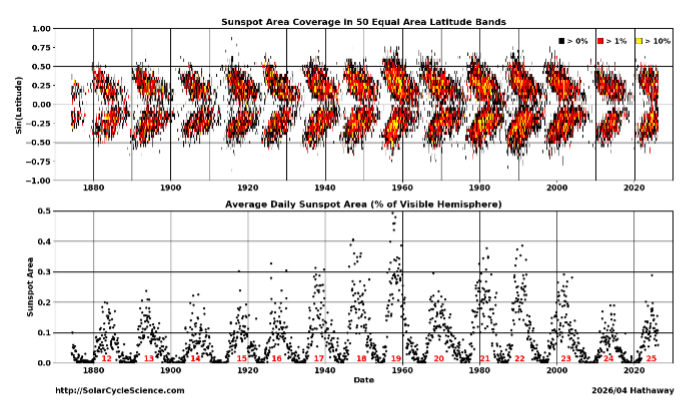
Figure 1: the top diagram shows the latitude on the y-axis and time from 1830 on the x-axis. This illustrates the locations of sunspots with time. At the start of a solar cycle, they appear at high latitudes and with time they appear at lower latitudes. This figure is known as the ‘butterfly’ diagram. The lower plot shows the sunspot area with time from 1830 until 2026 (suggesting an 11-year activity cycle). The figures are produced by Dr. David Hathaway and are available online.
The strong magnetic fields on the Sun are the sources of different kinds of energy releases. There are three main kinds of energy release:
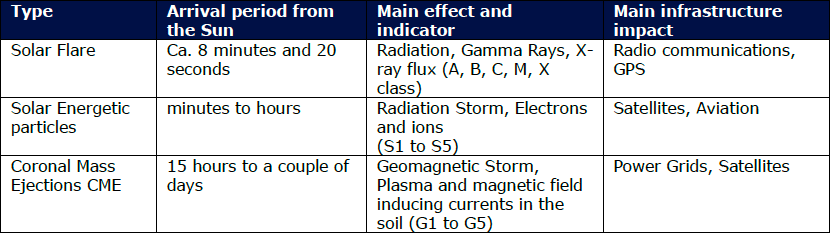
Table 1: type of solar energy releases, their main effects and infrastructure impact
- Solar flares are rapid bursts of electromagnetic radiation that occur within minutes and can reach gamma-ray energies, spanning much of the electromagnetic spectrum. This radiation reaches Earth in about 8 minutes 20 seconds. The NOAA Space Weather Prediction Center (SWPC) classifies flares using GOES satellite measurements of solar X-ray flux. Figure 2 shows an example of GOES X-ray data on a logarithmic scale, with flares ranging from A-class (smallest and most common) to X-class (largest and rarest). The period shown reflects low solar activity, with no major flares.
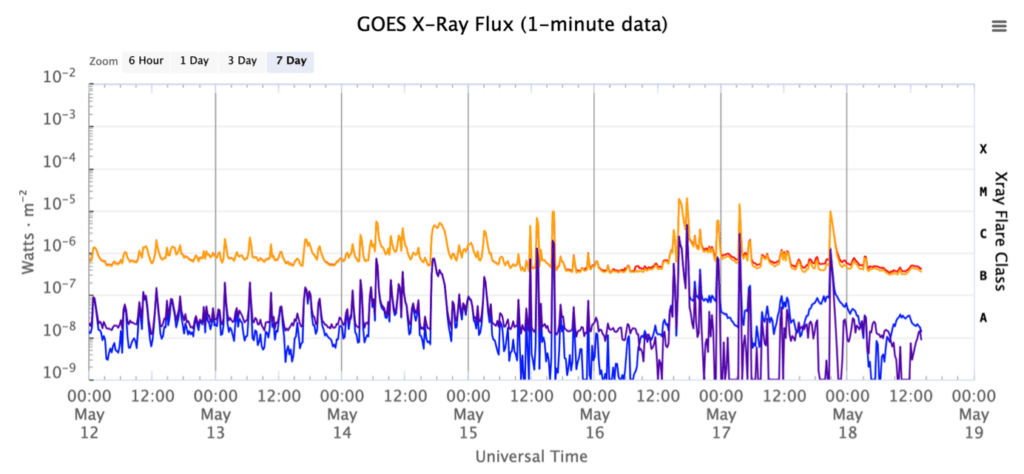
Figure 2: An example figure from the Space Weather Prediction Center showing 7 days of GOES X-ray flux data. The scale on the right-hand side of the plot is in the form A, B, C, M and X which increases in energy on a logarithmic scale. There can be over 100 X-flares during one solar cycle. Chart available online at https://swpc-drupal.woc.noaa.gov/products/goes-x-ray-flux
During a large solar flare, high-frequency radio waves that are used for communication can be degraded or even blocked completely.